6/5/06
The Billy Wilder comedy Kiss Me, Stupid is a middling entry in the directors cannon, and a film that generated some degree of ill-will against its creator in the Hollywood community. Enough people found this lightly tawdry comedy objectionable, that Wilder later commented that he made sure that his next film, the 1966 Matthau/Lemmon pairing The Fortune Cookie, have a fairly straight forward moral along conventional lines. But back to Stupid.
Kiss Me, Stupid stars Ray Walston and Cliff Osmond as a piano teacher (Orville J. Spooner) and service station operator (Barney Milsap) respectively. The two men live in the small town of Climax, Nevada (yes Wilder intended the name to have a double meaning), where they collaborate on song composition in their spare time, hoping to one day make it big. An opportunity to do just that comes along when a popular singer(Dean Martin who is playing a stereotyped version of himself, though in the film he is always referred to by his nickname of 'Dino') runs into some car trouble while passing through town.
With Dino being put up in Orville's house for the night while Barny 'fixes' his 'broken' car, the two anticipate having an easy time forcing the crooner to listen to their tunes, which they are sure he will love. However the sex-manic singer is more interested in finding a little action in the form of Mrs. Spooner, whose black negligee he stumbles upon, then in discovering new compositional talent. So Barny comes up with the idea of replacing Orville's wife Zelda (Mrs. Jack Lemon, Felicia Farr) for the night with Polly the Pistol (Kim Novak), a prostitute/waitress who works at towns only night spot. Mel Blanc also appears in a small cameo as Mrs. Spooners dentist.
The film contains all the standard Wilder/Diamond characters types, the schemer (Osmond), the dreamer (Walston), the womanizer (Martin), the prostitute with the heart of gold (Novak), and the idealized women (Farr). While all the pieces are there its still pretty mechanical, I mean I enjoyed it, it didn't disappoint, but it contained nothing the director hadn't done better in an earlier film. Compared to Wilders some what similar theatrical release of the previous year, that lost gem of a comedy that is Irma La Douce, Kiss Me, Stupid is merely an after thought.
Tuesday, June 26, 2007

24: Season 3 (2003-2004)
6/4/06
The 3rd season of Fox's 24 is generally considered its weakest. Now that doesn't mean its bad, it's just not as good as the others. I really didn't care for the first half of the season, they were trying to do something different, and I applaud them for that, but it just didn't quite work for me. Also the first eight hours of the President Palmer storyline ended to neatly. Anyways, this season does hold the distinction of having the only semi-humorous 24 sub-plot, namely the mysterious baby. That's really all I have to say about this season, looking forward to number four.
The 3rd season of Fox's 24 is generally considered its weakest. Now that doesn't mean its bad, it's just not as good as the others. I really didn't care for the first half of the season, they were trying to do something different, and I applaud them for that, but it just didn't quite work for me. Also the first eight hours of the President Palmer storyline ended to neatly. Anyways, this season does hold the distinction of having the only semi-humorous 24 sub-plot, namely the mysterious baby. That's really all I have to say about this season, looking forward to number four.
The Prime of Miss Jean Brodie (1969)
6/1/06
It was for The Prime of Miss Jean Brodie, an adaptation of the novel by (the now recently deceased) Muriel Spark, that Maggie Smith won a completely deserved Academy Award. Set at a privet girls school in 1930's Scotland, the feature starts out like your standard, inspiring and unconventional teacher movie. For the first forty minutes or so the film is just that, and not overly good at it either. Brodie is quite extreme, and none of the girls are particularly likeable. But the plot takes a dark turn there after, focusing more on Jean Brodies complicated personal life and strained relationship with pupil Sandy (an impressive performance by young Pamela Franklin). Robert Stephens and Gordon Jackson play Jeans two love interests, while Celia Johnson is Miss Mackay, the headmistress who never liked Miss Brodie.
Brodie is an interesting character, who starts out the film a tad over the top, and stays that way throughout, though we do get to look deeper and deeper into her complicated soul as the movie progresses. To give you a sense of her oddness, lets look at her admiration for Fascism, she literally gushes about Mussolini throughout the film. Her support of the Fascists brings out a, shall we say, unconventinal combination of traits in her character. First off she fancies the brown shirts in a highley romanticiesd way, a by product I suppose, of the fact that she lives in her own intellectually self-indulgent world, divorced from reality. What she sees as a quirk that exemplifies her unconventionality, others see as disturbing and dangerous. Though she is set up in one way, we are meant to come and see her in another. Miss Jean Brodie is dangerous, and she should probably not be influencing children. Now while she says she has devoted her life to "her girls", even that phrasing reveals that it is really all about her in the end, even if she could never admit as much to herself. Don't get me wrong, you'll probably not hate Miss Brodie, mostly you'll just pity her. I did not like this movie at first, but it really hit me out of left field in the second half and I have to give it good marks, though like Miss Brodie this film is not for young children, so be advised.
It was for The Prime of Miss Jean Brodie, an adaptation of the novel by (the now recently deceased) Muriel Spark, that Maggie Smith won a completely deserved Academy Award. Set at a privet girls school in 1930's Scotland, the feature starts out like your standard, inspiring and unconventional teacher movie. For the first forty minutes or so the film is just that, and not overly good at it either. Brodie is quite extreme, and none of the girls are particularly likeable. But the plot takes a dark turn there after, focusing more on Jean Brodies complicated personal life and strained relationship with pupil Sandy (an impressive performance by young Pamela Franklin). Robert Stephens and Gordon Jackson play Jeans two love interests, while Celia Johnson is Miss Mackay, the headmistress who never liked Miss Brodie.
Brodie is an interesting character, who starts out the film a tad over the top, and stays that way throughout, though we do get to look deeper and deeper into her complicated soul as the movie progresses. To give you a sense of her oddness, lets look at her admiration for Fascism, she literally gushes about Mussolini throughout the film. Her support of the Fascists brings out a, shall we say, unconventinal combination of traits in her character. First off she fancies the brown shirts in a highley romanticiesd way, a by product I suppose, of the fact that she lives in her own intellectually self-indulgent world, divorced from reality. What she sees as a quirk that exemplifies her unconventionality, others see as disturbing and dangerous. Though she is set up in one way, we are meant to come and see her in another. Miss Jean Brodie is dangerous, and she should probably not be influencing children. Now while she says she has devoted her life to "her girls", even that phrasing reveals that it is really all about her in the end, even if she could never admit as much to herself. Don't get me wrong, you'll probably not hate Miss Brodie, mostly you'll just pity her. I did not like this movie at first, but it really hit me out of left field in the second half and I have to give it good marks, though like Miss Brodie this film is not for young children, so be advised.
Nashville (1975)
5/30/06
Just minutes ago I finished Robert Altmans Nashville, a film that I have wanted to see for some time but also viewed in preparation for the upcoming A Prairie Home Companion. Nashville is a sort of War and Peace of country music, a character study film with too many characters. Yet despite the brush confusion of the piece at the beginning, its many storylines fade away to reveil a hard to define whole that make provocative statements about politics, humanity, and America. I don't know if I'd say this movie is really my thing, I think I'll have to think and reflect on it some more, but I do recognize that its some kind of genius because I hated the first half of it (and this is a 2 hour and 40 minute long movie), but had achieved detente with it by the end. Never-the-less an important film of the 1970's. I am however a 'supporter' of Altmans Jack Tanner mini-series Tanner 88', and Tanner on Tanner, both of which star Michael Murphy who played a political consultant in Nashville.
Just minutes ago I finished Robert Altmans Nashville, a film that I have wanted to see for some time but also viewed in preparation for the upcoming A Prairie Home Companion. Nashville is a sort of War and Peace of country music, a character study film with too many characters. Yet despite the brush confusion of the piece at the beginning, its many storylines fade away to reveil a hard to define whole that make provocative statements about politics, humanity, and America. I don't know if I'd say this movie is really my thing, I think I'll have to think and reflect on it some more, but I do recognize that its some kind of genius because I hated the first half of it (and this is a 2 hour and 40 minute long movie), but had achieved detente with it by the end. Never-the-less an important film of the 1970's. I am however a 'supporter' of Altmans Jack Tanner mini-series Tanner 88', and Tanner on Tanner, both of which star Michael Murphy who played a political consultant in Nashville.

Gilmore Girls: Season 1 (2000-2001)
5/29/06
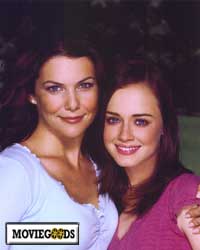
Now this is kind of embarising for me, but I'm coming out, I am a Gilmore Girls fan. I have a long history of flirting with this show (owing largely to its attractive leads and witty banter), wanting to watch it and then recoiling, thinking that somehow it would not be proper. First off the paly relationship between the lead mother and daughter characters of Lorelai (Lauren Graham) and Rory (Alexis Bledel) Gilmore seemed kind of creepy to me, I mean didn't the Lewinski's having something similar going on when mother told daughter to 'save that dress.' That creepiness factor was re-enforced by a first season episode of Six Feet Under, which used a clip of the show playing in the background to reinforce the 'not-rightness' of the mother/daughter relationship of some Fisher cousins. However television is a world of suspended disbelief, and if the writing is good and the characters are interesting, I am willing to bend to their logic. Also I found out that a married friend of mine and his wife watch the program regularly and that made viewing it seem okay. So some time later I started watching some 4th season reruns on ABC Family, this occurred at about the same time that a wave of Gilmore interest swept my household, and its wasn't long before we owned the first two seasons on DVD.
This is my review of the first season, when the show was at the height of its freshness. Now while this program is a 'chick-flick' for television, it is also one of the last refuges of screwball comedy, and has the wittiest TV dialogue this side of Aaron Sorkin. Also it is set in one of those TV small towns that you just want to move to, Stars Hollow, Connecticut. I am a big fan of televisions quirky little municipalities from Evening Shade, Arkansas, to Sicily Alaska, and Twin Peaks, Washington inbetween. Stars Hollow has a large cast of recurring local eccentrics, but its host program is really anchored to its titles namesake the Gilmore Girls, Lorelai and Rory. Lorelai came from an upercrust New England establishment family involved in international business, she had an unhappy childhood with her largely absentee father Richard (Edward Herrmann) and domineering mother Emily (Kelly Bishop). At 16 she got 'with child', and as soon as she was old enough left home with her young daughter and took up both residence and employment at a historic Connecticut inn. The series takes up just under 16 years after Rorys birth (which was apparently in the fall of 1984), with Lorelai now managing the inn, and her daughter just acepted to a prestigious private school called Chilton.
The action of the series starts when Lorelai's parents agree to give their daughter the money she needs to send Rory to Chilton, in exchange for the eventual repayel of the cash and a bigger part in the two girls lives, manifested chiefly in mandatory Friday night dinners together. Aside from the intra-family elements of the program, much time is spent on the lead characters love lives, and with their friends and the wacky towns folks. Melissa McCarthy is Lorelais best friend Sookie, a cook at the inn, while Keiko Agena plays Rorys best friend Lane Kim, a closet rock and roll lover who bristles under the rule of her strict Seventh-day Adventist Korean parents (though we only ever see the mother). Scott Patterson is Luke Danes, Lorelai's apparent soul mate and owner of the local cafe, while Jared Padalecki is Dean Forrester, Rory's first boyfriend. Liza Weil is Rory's sometimes friend, sometimes nemesis Paris Geller, and Yanic Truesdale is Michel Gerard, a stereotypically rude French receptionist at the inn, who left France because he can not stand French people. Liz Torres is Miss Patty, a local dance instructor and one time Broadway star who is the first seasons featured wacky local.
Basically this is just a really fun show with unique sensibilities. It is loaded with obscure references courtesy of head writer and series creator Amy Sherman-Palladino, who always manages to make her characters well rounded enough to avoid being cliches. Things progress in the series as they do in real life, and you are not returned to square one at the end of every episode. Though in recent years its viewership has fallen off somewhat, and many are unhappy with the direction the program has taken, at least in its early seasons it truly is a treasure and well worth the embarrassment that might come with watching.
Now this is kind of embarising for me, but I'm coming out, I am a Gilmore Girls fan. I have a long history of flirting with this show (owing largely to its attractive leads and witty banter), wanting to watch it and then recoiling, thinking that somehow it would not be proper. First off the paly relationship between the lead mother and daughter characters of Lorelai (Lauren Graham) and Rory (Alexis Bledel) Gilmore seemed kind of creepy to me, I mean didn't the Lewinski's having something similar going on when mother told daughter to 'save that dress.' That creepiness factor was re-enforced by a first season episode of Six Feet Under, which used a clip of the show playing in the background to reinforce the 'not-rightness' of the mother/daughter relationship of some Fisher cousins. However television is a world of suspended disbelief, and if the writing is good and the characters are interesting, I am willing to bend to their logic. Also I found out that a married friend of mine and his wife watch the program regularly and that made viewing it seem okay. So some time later I started watching some 4th season reruns on ABC Family, this occurred at about the same time that a wave of Gilmore interest swept my household, and its wasn't long before we owned the first two seasons on DVD.

This is my review of the first season, when the show was at the height of its freshness. Now while this program is a 'chick-flick' for television, it is also one of the last refuges of screwball comedy, and has the wittiest TV dialogue this side of Aaron Sorkin. Also it is set in one of those TV small towns that you just want to move to, Stars Hollow, Connecticut. I am a big fan of televisions quirky little municipalities from Evening Shade, Arkansas, to Sicily Alaska, and Twin Peaks, Washington inbetween. Stars Hollow has a large cast of recurring local eccentrics, but its host program is really anchored to its titles namesake the Gilmore Girls, Lorelai and Rory. Lorelai came from an upercrust New England establishment family involved in international business, she had an unhappy childhood with her largely absentee father Richard (Edward Herrmann) and domineering mother Emily (Kelly Bishop). At 16 she got 'with child', and as soon as she was old enough left home with her young daughter and took up both residence and employment at a historic Connecticut inn. The series takes up just under 16 years after Rorys birth (which was apparently in the fall of 1984), with Lorelai now managing the inn, and her daughter just acepted to a prestigious private school called Chilton.
The action of the series starts when Lorelai's parents agree to give their daughter the money she needs to send Rory to Chilton, in exchange for the eventual repayel of the cash and a bigger part in the two girls lives, manifested chiefly in mandatory Friday night dinners together. Aside from the intra-family elements of the program, much time is spent on the lead characters love lives, and with their friends and the wacky towns folks. Melissa McCarthy is Lorelais best friend Sookie, a cook at the inn, while Keiko Agena plays Rorys best friend Lane Kim, a closet rock and roll lover who bristles under the rule of her strict Seventh-day Adventist Korean parents (though we only ever see the mother). Scott Patterson is Luke Danes, Lorelai's apparent soul mate and owner of the local cafe, while Jared Padalecki is Dean Forrester, Rory's first boyfriend. Liza Weil is Rory's sometimes friend, sometimes nemesis Paris Geller, and Yanic Truesdale is Michel Gerard, a stereotypically rude French receptionist at the inn, who left France because he can not stand French people. Liz Torres is Miss Patty, a local dance instructor and one time Broadway star who is the first seasons featured wacky local.
Basically this is just a really fun show with unique sensibilities. It is loaded with obscure references courtesy of head writer and series creator Amy Sherman-Palladino, who always manages to make her characters well rounded enough to avoid being cliches. Things progress in the series as they do in real life, and you are not returned to square one at the end of every episode. Though in recent years its viewership has fallen off somewhat, and many are unhappy with the direction the program has taken, at least in its early seasons it truly is a treasure and well worth the embarrassment that might come with watching.
Night and Day (1946)
5/29/06
Night and Day is a white-washed musical biography of composer Cole Porter. As the real life of Mr. Porter was not fit for a mainstream motion picture of the 1940's, the writers obviously took plenty of liberty's in their screenplay. In fact in the more recent and true to life film about Porter, De-Lovely the characters comment about how inaccurate this film was. Having now sat throughout the movie I find yet further evidence to support Irving Berlins claim that with the exception of Yankee Doodle Dandy (and I suppose now Amadeus), every bio-film about a composer stinks. Cary Grant plays homosexual rake Porter as a heterosexual workaholic, and Alexis Smith plays the composite feeling Linda Lee Porter. Monty Woolley and Mary Martin play themselves in the film. Despite a wealth of strong musical material the only memorable production number in the thing is Begin the Beguine. A disappointment.
Night and Day is a white-washed musical biography of composer Cole Porter. As the real life of Mr. Porter was not fit for a mainstream motion picture of the 1940's, the writers obviously took plenty of liberty's in their screenplay. In fact in the more recent and true to life film about Porter, De-Lovely the characters comment about how inaccurate this film was. Having now sat throughout the movie I find yet further evidence to support Irving Berlins claim that with the exception of Yankee Doodle Dandy (and I suppose now Amadeus), every bio-film about a composer stinks. Cary Grant plays homosexual rake Porter as a heterosexual workaholic, and Alexis Smith plays the composite feeling Linda Lee Porter. Monty Woolley and Mary Martin play themselves in the film. Despite a wealth of strong musical material the only memorable production number in the thing is Begin the Beguine. A disappointment.

Flightplan (2005)
5/28/06
Flightplan stars Jodie Foster in an action heroin role as a recently widowed engineer returning to the U.S. from Germany with her young daughter and the body of her late husband. Of course she just happens to be flying across the Atlantic on a plane which she knows inside-out, and fall asleep long enough to awake and find that her daughter has disappeared Bunny Lake-like, with no one on board seeming to remember that the little girl was ever on the plane. The rest of the movie proceeds along fairly predictable lines, with Foster and co-star Peter Sarsgaard giving fine if not particularly remarkable performances. A fair to average film. For a better movie about an ex-patriot engineer with a young daughter, and a possible crises aboard a new airplane see the 1951 Jimmy Stewart feature No Highway in the Sky.
Flightplan stars Jodie Foster in an action heroin role as a recently widowed engineer returning to the U.S. from Germany with her young daughter and the body of her late husband. Of course she just happens to be flying across the Atlantic on a plane which she knows inside-out, and fall asleep long enough to awake and find that her daughter has disappeared Bunny Lake-like, with no one on board seeming to remember that the little girl was ever on the plane. The rest of the movie proceeds along fairly predictable lines, with Foster and co-star Peter Sarsgaard giving fine if not particularly remarkable performances. A fair to average film. For a better movie about an ex-patriot engineer with a young daughter, and a possible crises aboard a new airplane see the 1951 Jimmy Stewart feature No Highway in the Sky.
Subscribe to:
Posts (Atom)